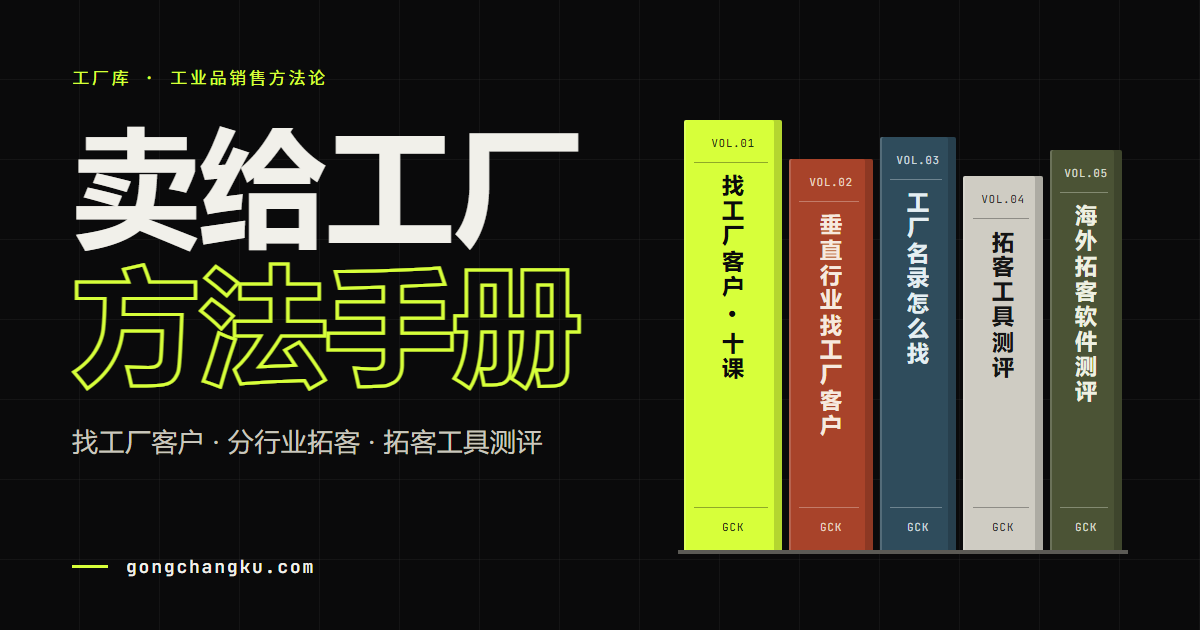

VOL.02
Finding Factory Customers by Industry
50 industry playbooks for upstream suppliers selling into Chinese factories across auto-parts, electronics, machinery, HVAC, telecom, robotics, watches, bicycles, smart-locks, elevators, steel-structure, baby products and more.
50 articles · about 13 h
- Where Are Your Auto Parts Factory Customers? How Upstream Suppliers Build the List Auto parts factories are a core customer segment for upstream suppliers of CNC tooling, inspection equipment, and surface-treatment chemicals — yet traders masquerading as factories are rampant. This article analyzes the industry structure and lays out a three-step screening method that uses IATF 16949 certification, new-model sourcing nominations, and other industry signals to help upstream sales teams lock onto genuine parts manufacturers and build a systematic lead list. 14 min
- Keep Reaching Traders Instead of Injection-Molding Factories? A Method to Filter for Real Plants Suppliers selling plastic pellets and masterbatch face one persistent problem: telling a genuine injection-molding factory from a trading middleman. This article breaks down where injection-molding factories cluster, what hard signals separate real factories from traders, and a three-step field-tested method to build a usable lead list from core industrial belts like Yuyao and Taizhou Huangyan. 15 min
- Hardware Factories Aren't in Your Contact List — How Upstream Suppliers Find the Ones Actually Producing For upstream suppliers selling into hardware & metal factories, the real headache isn't a shortage of prospects — it's telling genuine manufacturers apart from market-stall traders. This article breaks down a three-step screening method anchored in the Yongkang and Xiaolan industrial clusters, so you can pull real factories with die-casting, stamping, and plating lines out of a cluttered lead list. 13 min
- Supplying PCB/SMT Factories Starts with One Step: Finding the Right Plants For upstream suppliers selling solder paste, stencils, and SMT components, the real problem isn't product quality — it's that customer lists are full of traders. Tianxia Gongchang identifies genuine PCB/SMT factories running active production lines from 4.8 million manufacturing enterprises in China, filtering to a convertible lead list in three steps: industrial cluster, certification, and expansion signals. 17 min
- Prospecting Food-Processing Factories: Six Signals That Reveal Who Is Really Buying Packaging suppliers facing 43,000+ above-scale food manufacturers in China need a sharper filter. This article breaks down three prospecting lines — SC permit verification, retail-channel supply signals, and capacity-expansion windows — and maps out ready-to-use screening paths for the Luohe, Weifang, and Quanzhou industrial clusters. 17 min
- Medical Device Factory or Trader? Tell Them Apart Before You Visit Medical device factories are high-value customers for upstream suppliers in cleanroom engineering, medical-grade materials, and sterilization services. But the registration-certificate system is complex and genuine manufacturers are easily confused with traders. This article gives a three-step screening method using signals like medical device registration certificates, ISO 13485, and cleanliness class to help upstream sales lock in real device makers. 17 min
- Struggling to Find Textile and Garment Factory Customers? It Is Not the Pitch, It Is the List Upstream suppliers selling sewing equipment to textile and garment factories face an industry where production is tightly clustered in a handful of industrial belts, yet factory scale runs from large OEM plants to family workshops. This article works through the key clusters — Keqiao, Nantong, Changshu, and Foshan — and breaks down a three-step screening method for pulling genuine sewing factories out of lists contaminated by trading stalls. 16 min
- Selling into Packaging and Printing Factories: A Copy-and-Use Prospecting Checklist Ink suppliers face more than 10,000 above-scale packaging & printing enterprises across China — but how do you reach the ones with presses actually running? This article breaks down three prospecting threads: equipment investment signals, green-printing upgrade windows, and brand/e-commerce packaging contracts. Reusable screening paths and a keyword dictionary included. 16 min
- How to Mine Chemical Factory Customers: Watch Park-Admission and Expansion Signals Suppliers selling reactors or industrial instruments face fine chemical factories scattered across chemical parks nationwide. How do you filter out targets with real purchasing needs? This article works through three lines of evidence — chemical-park admission rosters, work-safety permits, and expansion signals — to map out a three-step screening path suited to reactor and instrumentation vendors. 15 min
- Screening New-Energy Factory Customers: From Funding and Expansion Signals to Real Production Lines New energy, lithium battery, and photovoltaic factories are high-value clients for upstream suppliers of testing equipment and process consumables. But the sector expands fast, and trading integrators are mixed in with real manufacturers. This article offers a three-step prospecting method built on industry-specific signals — funding announcements, capacity disclosures — to help upstream sales lock onto genuine manufacturing entities and build a systematic lead list. 15 min
- Stop Prospecting Furniture-Factory Clients From Your Contact List Upstream suppliers of panel boards and edge banding waste weeks on brand owners and traders hidden inside an 180,000-entity industry. This article shows how to pinpoint real cut-and-edge production lines in Shunde and Houjie, catch the E0 panel upgrade window, and build an actionable factory client list with a three-step method. 15 min
- Prospecting Ceramics & Sanitaryware Factories by Production Cluster: One Route, One Region For upstream suppliers — glaze makers, kiln-equipment vendors — the most efficient approach to the ceramics and sanitaryware sector is not blasting industry keywords, but sweeping production clusters like Foshan, Chaozhou, Zibo, and Jingdezhen. This article explains the cluster structure and delivers a three-step prospecting method, combining water-efficiency certification, CCC mandatory standards, and kiln-upgrade signals to build verified, actionable factory lead lists. 16 min
- When Is the Right Time to Call on Footwear and Leather Goods Factories Procurement windows at footwear and leather goods factories cluster tightly in the two to three months before peak season. This article covers industrial-cluster geography, timing judgment, a three-step prospecting method, and a ready-to-use checklist to help upstream suppliers — shoe machinery, leather materials, and sole materials — systematically lock in a list of genuine factories across Jinjiang, Wenzhou, Huidong, and Baigou. 15 min
- How Much Can You Save by Making Fewer Dead-End Calls on Machinery Factories? Machinery and equipment factories are high-value customers for upstream suppliers of castings and hydraulic components, yet the sector is crowded with system integrators and traders. This article converts wasted call time into a real cash figure, then provides a three-step screening method to help upstream sales teams lock onto genuine equipment manufacturers and cut futile prospecting. 16 min
- Narrowing a Home-Appliance Factory List from Thousands to a Hundred Worth Chasing For upstream suppliers selling motors and control boards, the real problem isn't product competitiveness — it's that their lead lists are flooded with OEM brand owners and traders. Tianxia Gongchang identifies real assembly-line factories from 4.8 million manufacturing enterprises in China, filtering through industrial cluster, CCC/energy-efficiency certification, and new-product signals to compress thousands of candidates into a hundred genuinely actionable targets. 16 min
- In the LED Lighting Industry, Who Is a Real Factory and Who Is a Contract Labeler? Guzhen, Zhongshan hosts over 8,000 lighting enterprises, yet most are market-stall distributors or simple assembly shops rather than genuine manufacturers. For upstream suppliers of LED chips and driver power supplies, the real problem is how many order-flipping middlemen have crept into the lead list. Tianxia Gongchang identifies real factories among 4.8 million Chinese manufacturers, helping upstream sales build an actionable list of genuine LED luminaire makers. 16 min
- Mold & Die Factory Lead Lists: The One Step Most People Get Wrong Suppliers selling mold steel or CNC machining centers often contaminate their lead lists from the very first step—mixing in traders and order-flipping middlemen. This article breaks down the industrial cluster geography of China's mold manufacturing sector, the key signals that distinguish genuine mold factories, and a three-step practical method for finding real mold factory customers in Shenzhen, Ningbo, and Suzhou Kunshan. 13 min
- Picking Real Pharmaceutical Manufacturers from Drug-License Lists Pharma and API factories are high-value customers for GMP cleanroom contractors, pharma equipment makers, and excipient suppliers. But the sector mixes traders with actual manufacturers, and a drug manufacturing license differs fundamentally from a drug distribution license. This article covers China's licensing system and a three-step method — using GMP status, drug manufacturing licenses, and bioequivalence signals — to help upstream sales identify real pharma factories. 16 min
- Where Construction-Machinery Factories Hide Their Buying Windows For upstream suppliers of hydraulic components and specialty steel, reading a construction-machinery factory's procurement rhythm is notoriously hard. This article breaks down four core signals — capacity expansion, tender wins, export orders, and engineer hiring — explains the procurement logic behind each, and walks through a three-step prospecting method so upstream sales reps are already at the door when the buying window opens. 16 min
- Selling Upstream to Toy Factories: How to Filter Out Trading Companies That Take Orders but Own No Production Lines Suppliers of toy safety-testing services or plastic pellets face tens of thousands of toy businesses across Chenghai and Dongguan. This article walks through three lines of analysis — industrial-cluster identification, 3C/EN71/ASTM F963 certification windows, and peak-season expansion cycles — to show how export-order signals can be reverse-engineered into a verified list of factories with real production lines. 15 min
- Fastener Factories Aren't Created Equal: Which Tier Holds Your Real Customers If you sell cold-heading machines or wire rod, your biggest headache isn't a shortage of prospects — it's that genuine factories are buried inside thousands of look-alike company names. This article breaks down China's fastener industrial clusters, how to tell real manufacturers from traders, and a three-step field-tested approach to surfacing high-value customers from Yongnian (Handan) to Haiyan (Zhejiang). 14 min
- Selling Upstream to Valve and Pump Factories: Stop Mistaking Traders for Manufacturers Upstream suppliers selling castings or seals to valve factories share one frustration: not a shortage of prospects, but traders and agents masquerading as manufacturers. This article uses Wenzhou Yongjia and Yuhuan as anchors, then walks through a three-step method to identify genuine factories with their own casting and machining lines — so you build a verified lead list before hitting the road. 15 min
- Ten Thousand Bearing Factories Nationwide — Fewer Than One in Ten Will Actually Buy from You China has roughly 10,000 bearing manufacturers, but fewer than 30% operate genuine ring-grinding and heat-treatment lines. Of those, only a fraction have active procurement needs that match bearing steel or grinding machine products. This article breaks down the three major bearing industrial clusters, the signals that identify real factories, and a three-layer filtering method — scale, downstream, precision — to systematically reach genuine bearing factory customers. 14 min
- The CCC Threshold in Wire & Cable Actually Filters Out Half the Fake Factories for You For upstream suppliers of copper rod and insulation compounds, wire and cable is a high-priority sector, yet relabeling and aluminum-for-copper fraud make most prospect lists noisy. China Compulsory Certification (CCC) is issued per factory, one certificate per site and non-transferable, making it the hardest natural filter between real manufacturers and traders. This article explains the CCC logic and a three-step method to lock onto genuine cable manufacturers. 15 min
- Eight Out of Ten Chinese Eyewear Factories Cluster in Three Places — Here's How to Route Your Sales Calls China's eyewear factories are highly concentrated in three production hubs — Danyang, Shenzhen Henggang, and Xiamen Tongan — yet traders and showroom brands crowd the same directories. For upstream suppliers selling lens resin monomers or injection-molding equipment, routing visits by cluster, reading the right procurement signals, and using Tianxia Gongchang to confirm real factories turns a single verified list into more pipeline than three months of random cold calls. 14 min
- Hidden Champions Inside Stationery Factories: How to Tell the Real Ones from the Assemblers China's pen-making industry is heavily concentrated in three clusters — Tonglu Fenshui, Ningbo, and Wenzhou — yet assembly workshops and traders flood the same directories. Upstream suppliers selling pen tips, ink, or injection-molded parts can replace three months of cold calls with a precise lead list, once they learn to read the right factory-capability signals and time outreach to the back-to-school procurement window. 15 min
- Yangjiang Knife Factories Are Everywhere — How Upstream Suppliers Stop Wasting Trips About 80% of China's exported cutlery comes from Yangjiang, Guangdong; stainless-steel kitchenware clusters in Jieyang and Chaozhou. Real factories and polishing-only stalls register side by side, making it easy for upstream suppliers — selling sheet or heat-treatment equipment — to call repeatedly on entities that buy nothing. This article breaks down cluster dynamics, factory identification signals, and a three-step prospecting playbook. 15 min
- Two Moves Every Veteran Sales Rep Makes Before Opening a Pitch at a Coatings or Adhesives Factory Upstream suppliers selling resins or dispersion/grinding equipment face a dense, noisy landscape of coatings and adhesives companies in Shunde, Jiangmen, and Changzhou — where repackagers and private-label traders far outnumber genuine manufacturers. This article breaks down two quick on-site checks and a three-step prospecting path to separate real production facilities from distributor fronts before the first call. 16 min
- Tire and Rubber Factory Customers: Start by Mapping Whose Supply Chain They Feed Upstream sales reps selling carbon black, rubber additives, or vulcanization equipment don't find tire and rubber factory customers by searching industry keywords — they reverse-engineer OEM supplier announcements and export-certification registries. This guide starts from the Shandong Guangrao and Dongying industrial cluster and walks through a three-step method to isolate genuine manufacturers that run a full banbury-to-vulcanization production line. 16 min
- Who Calls the Shots at a Motor Factory: Find the Right Buyer and Save Six Months China has roughly 2,270 above-scale motor manufacturers. Upstream suppliers of enameled wire, silicon steel, and winding equipment struggle to break in — because purchasing authority is fragmented. Efficiency class upgrades, downstream application focus, and product mix all shift who actually decides. This article decodes the decision chain across home-appliance, automotive, and industrial motor factories. 18 min
- HVAC Factory Procurement Moves in Tides — Here's How to Time Your Approach For upstream suppliers selling compressors or heat exchangers to HVAC factories, the hardest part isn't finding customers — it's that procurement peaks cluster tightly and windows close fast. This article maps the seasonal rhythm of the HVAC industry, anchors it across three major industrial clusters (Zhuhai, Shunde, Hefei), and walks through a three-step method to hit procurement cycles precisely and lock in a list of genuine OEM assemblers. 16 min
- Don't Prospect Agricultural-Machinery Factories by Registered Address Alone Upstream sales reps selling hydraulic components and rubber parts into the ag-machinery sector share a common blind spot: filtering by registered address and missing the factories that actually buy. This article breaks down the mismatch between registration address and production address, explains the Stage III-to-IV emissions switch as a procurement window signal, and walks through a three-step prospecting method for building a lead list that stands on solid ground. 16 min
- The Deputy Chief Engineer Is Your Real Target Inside a Shipyard China has ranked first globally in shipbuilding output for 15 consecutive years, with Jingjiang, Zhoushan, and Nantong as the three core clusters. Unlike most manufacturing sectors, purchasing decisions in a shipyard sit with the deputy chief engineer, not procurement. This article unpacks the shipyard decision chain, genuine-shipyard identification signals, and a three-step prospecting method for suppliers of marine cables and ship coatings. 16 min
- Build Your Instrument & Meter Factory Lead List with Three Spreadsheets For salespeople selling metering chips or sensor modules to instrument and meter factories, the hard part is not finding names — it is separating genuine manufacturers from the dozens of 'XX Meter Technology' companies that are actually traders. This article walks through three spreadsheets — a screening list, a qualification filter, and a signal tracker — to build a ready-to-work instrument factory lead list. 16 min
- Glass Factory Customers Come in Two Types — Everything Else Is Noise Upstream sales selling glass furnaces or molybdenum electrodes rarely struggle to find names — they struggle because most names on a 'glass factory' list turn out to be traders or small downstream fabricators, while the float-glass integrated plants that actually consume furnaces stay unreachable. This article splits the glass industry into flat glass (capital-heavy) and deep-processing (custom) customers, giving upstream sales the logic to build a clean, targeted lead list. 16 min
- Selling Upstream to Synthetic-Fiber Factories: Which Layer Do You Cut First PTA and MEG suppliers face two distinct factory layers inside the synthetic-fiber supply chain — polymerization and spinning. Which layer you target first determines your revenue ceiling. This article uses Tongxiang, Xiaoshan, and Fujian Changle as entry points to unpack the segmentation logic of polyester, nylon, and spandex, and walks through a three-step method for separating genuine polymerization manufacturers from fiber traders. 15 min
- Why Telecom Equipment Factories Never Call You Back Telecom equipment factories run on project-driven procurement cycles, with technical reviews lasting six months or more. Cold calls land on engineering gatekeepers, not the actual buyers. This article breaks down the decision structure inside telecom equipment factories from the perspective of optical transceiver cage and connector suppliers, and delivers a three-step prospecting method plus a reusable industry screening checklist. 15 min
- Breaking Down a Surveillance Camera Factory Like a Production Line The surveillance camera industry clusters in Hangzhou Binjiang, yet the line between real manufacturers and traders is blurry. Upstream suppliers selling CMOS sensors or lenses often spend months calling on traders they mistake for factories. This article breaks the supply chain into five layers — SoC, lens, IR board, housing, and AI algorithm — and maps the upstream entry point at each layer so salespeople can identify the real buyer by production structure, not brand name. 15 min
- Bigger Isn't Better in Wooden Door: Which Factories Upstream Sales Should Target First Franchise showrooms are everywhere in wooden door — but a storefront is not a factory. Upstream sales of hinges, locks, and edge banding most often waste time queuing at large brands whose supply chains are already locked in. Mid-size factories in expansion mode are the real sweet spot. This article uses the Jiangshan and Wuyi industrial clusters to show how to identify genuine wooden door manufacturers and catch the E0 board upgrade and export procurement windows. 16 min
- The 30 Days Before a Welding Factory Owner Signs Off — That's When You Need to Reach Them The procurement window at welding equipment and consumables factories is short: from the first signal to the owner's sign-off is typically around 30 days. Upstream sales reps selling inverter modules or copper-core wire can't afford to miss that window. This article lays out a three-step prospecting method to help you reach genuine manufacturing entities in industrial clusters like Wuxi and Shanghai before the decision is made. 16 min
- Nine Out of Ten Watch Factories You Visit Don't Actually Make Anything Shenzhen hosts China's largest watch cluster, yet Shuibei–Luohu is filled with showroom factories trading under a manufacturer's name while doing only OEM labeling and assembly. Factories holding a genuine CMC type-approval, owning a movement line, or running a case shop are far rarer than they appear. Upstream suppliers can apply a three-step method — pool by zone, read procurement signals, verify factory status in Tianxia Gongchang — to cut the noise before the first visit. 15 min
- Finding Customers in Bicycle and E-Bike Manufacturing: Work Down from the Finished Vehicle, One Tier at a Time The bicycle and e-bike supply chain runs from vehicle assemblers down through motors, battery packs, and precision components — each tier a separate supplier ecosystem. Upstream sales reps who treat OEM badge assemblers as real factory customers routinely come away empty-handed. This article breaks the chain down tier by tier and shows how to locate the genuine procurement decision-makers. 16 min
- Nobody Picks Up in Industrial Robotics? Because You Can't Tell a Robot Body Maker from a System Integrator In industrial robotics, robot body manufacturers and system integrators are two entirely different buyer types with non-overlapping procurement needs. If you sell servo motors or reducers, calling an integrator is a wasted call. This article shows upstream suppliers how to tell the two apart using industrial cluster targeting, CR certification, and signal capture — and build a list of buyers who actually purchase. 16 min
- Commercial Kitchen Equipment Factories Think Like Restaurants, Not Like Home Appliance Plants Upstream suppliers selling stainless-steel sheet or refrigeration compressors to commercial kitchen equipment factories often make one mistake: treating these accounts like home-appliance plants. This article unpacks the B2B purchasing logic specific to commercial kitchen equipment, maps the Zhongshan and Shenzhen clusters, and walks through a three-step method for identifying real factories—those with laser-cutting lines and CCC/NSF credentials—versus engineering firms. 15 min
- The Peak Season for Sports Equipment Factories Is Narrower Than You Think Sports equipment factories concentrate their procurement into a tight Q3–Q4 window each year — outside that window, doors are essentially closed. This article covers the industrial-cluster landscape, how to read Olympic and Black Friday cycles, a three-step prospecting method, and a ready-to-use checklist for upstream suppliers selling sports fabrics or plastic components into the real factory networks of Ningjin, Jinjiang, Nantong, and Cixi. 16 min
- Smart-Lock Factories Are Still Evolving — Lock In the Next Supply Cycle Before It Opens Smart-lock OEMs refresh specifications every six to twelve months, which means upstream suppliers selling lock cylinders or fingerprint modules must enter before each new product cycle begins — not after purchase orders go out. This article maps the industrial clusters (Xiaolan, Wenzhou), explains how to identify genuine manufacturing entities, and walks through a three-step method for building an actionable prospect list before the next supply window opens. 16 min
- Elevator OEMs Run a Year-Long Buying Cycle — Here's How Upstream Suppliers Stay in Step Selling wire ropes or control cabinets to elevator factories? The real challenge isn't sourcing leads — procurement cycles span a year or more, from project initiation through type testing, tendering, and delivery. This article maps three industrial clusters (Shanghai, Suzhou, Huzhou Nanxun) and lays out a three-step method for distinguishing genuine OEMs from installation operators, and timing outreach to match an actual purchasing window. 16 min
- Steel-Structure Factory Customers Follow the Project — So Should Your List Steel-structure factories live and die by project cycles — procurement swings from peak to zero between jobs. Upstream suppliers of structural steel and welding consumables don't struggle to find factories; they struggle to find ones with active projects right now. This article presents a three-step dynamic prospecting method to continuously identify genuine steel-structure manufacturers with work in progress across the Anhui, Zhejiang, Hebei, and Shandong clusters. 17 min
- Outdoor Gear Factories Buy in Just Three Months — Don't Call the Rest of the Year Tent and sleeping bag factories concentrate their material procurement into two short windows each spring and autumn. Miss those windows, and even the best waterproof fabrics and zippers won't get a hearing. This article maps the industrial clusters of Zhejiang and Fujian, explains how to tell real factories from traders, and gives upstream suppliers of waterproof fabrics and tent zippers a three-step prospecting method plus a ready-to-use screening checklist. 17 min
- Three Gates Baby-Product Factories Make You Clear Before They Add You to the Vendor List Baby-product factories are among the toughest customers for upstream suppliers to crack — quality thresholds, certification walls, and on-site audits stack up in layers, stopping most suppliers at the very first gate. Starting from the Quanzhou-Jinjiang and Shanghai-Jiangsu industrial clusters, this article breaks down exactly what each gate demands and helps upstream sales reps who sell nonwoven fabric and absorbent materials build a verified factory list. 17 min
MORE